Oak tree care in Grants Pass is mostly about doing less, and doing it well: light pruning, mistletoe control when it gets heavy, and keeping water, soil and machines off the roots. Phoning (541) 291-5564 gets you one independent tree service near Grants Pass that holds an Oregon CCB license. See if an ISA Certified Arborist is available to look at your oak.
Native oaks and planted oaks
Many of the big old oaks on rural land around Grants Pass are Oregon white oak, a native tree that handles dry summers. Oaks planted along streets and in newer yards are often other species.
The city's street tree permit application lists swamp white oak, chinkapin oak and willow oak among its approved street trees, all marked drought tolerant. Those trees came from nurseries and are usually younger. A native Oregon white oak can be very old, and it may not adjust well to sudden changes around its roots. Tell the tree service which kind you have, or ask it to identify the tree, since care differs.
Mistletoe clumps on oak branches
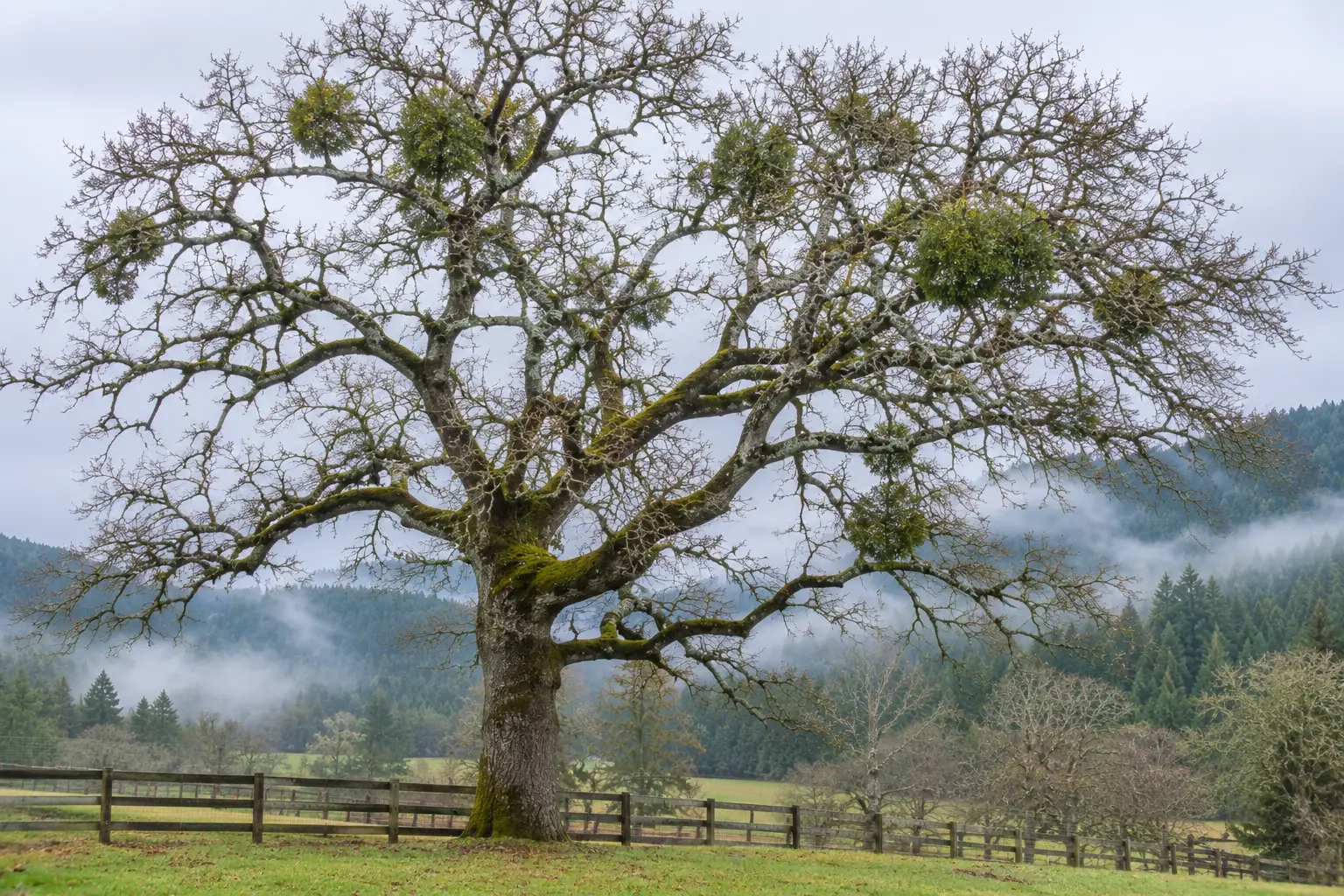
The round green clumps you see in a bare oak in winter are usually true mistletoe, a plant that grows on the branches and draws water from the tree. A few clumps are common and usually do little harm.
OSU Extension's mistletoe publication (EM 9679, published November 2021, reviewed 2026) names Oregon white oak as a host. It says the effects are usually negligible, but trees with many infections can lose growth, suffer branch dieback and feel drought stress more. Birds spread the seeds, since the berries ripen late in the year and stick to them. OSU says it does not normally recommend treatment. If the tree is struggling or you dislike the look, pruning out the mistletoe gives a few years of relief and has to be repeated.
The PNW Plant Disease Management Handbook adds two points. Cutting off only the green shoots lets new sprouts grow back from the branch. Removing heavy infection has been suggested to help oaks cope with drought in southern Oregon, though the handbook notes there are no replicated research trials behind that idea.
In practice, a tree service can cut out infected small branches entirely, and knock back clumps on big limbs that should not be removed. Plan on a return visit every few years. The mistletoe and oak problems guide goes into more detail.
Pruning a mature oak
A healthy mature oak needs little pruning, and every large cut is a wound it has to wall off. Pruning should have a reason, such as dead wood over a path, clearance over a roof or a limb rubbing another.
The International Society of Arboriculture's guide to pruning mature trees says that, as a rule, no more than 25 percent of the crown should be removed at once, and less on mature trees. It warns that removing a single large limb can leave a wound that may never close, and that cuts should sit just outside the branch collar, not flush with the trunk. ISA also advises against heavy live pruning right after the spring growth flush.
For an old oak, good work looks like this:
- Dead and broken branches come out first. This is the most useful cut on most old oaks.
- Mistletoe is cut out of small branches where the branch can go.
- Long limbs over a roof or drive are reduced back to a side branch, not stubbed.
- Live wood removed stays well under the 25 percent mark, often far less.
- No topping, and no climbing spikes on a tree that is staying.
Ask the company to point out each major cut before it starts. If a crew suggests "lifting" an old oak high off the ground, ask why; heavy raising removes a lot of live wood from a tree that may not replace it.
Water, soil and the root zone
Most harm to old oaks starts at the roots, not the crown. Roots spread much farther than most people expect and sit near the surface.
The Oregon Department of Forestry's Mediterranean oak borer fact sheet, dated May 2026, says oak roots extend 2 to 3 times farther than the width of the canopy. An OSU Extension article on keeping trees alive, from July 2024, says most of a tree's water-absorbing roots are in the top 12 to 18 inches of soil. The same article names Oregon white oak among the species that can handle summer drought once established, and it warns that overwatering can drown roots.
What that means for an oak in your yard:
- Keep trenching, grading, new driveways and parked equipment outside the area under and well beyond the canopy where you can.
- Do not pile soil, gravel or firewood against the trunk or over the roots.
- Avoid turning the ground under an old native oak into a watered lawn or garden.
- If a young oak needs water in its first years, OSU's article says to water at the root base and around the drip line, not on the trunk or leaves.
If you are building near a big oak, bring in a tree service before the excavator arrives. In Grants Pass, trees the City Council has named Heritage Trees have extra rules, including fencing to the drip line during construction, under the city's tree code.
Signs of trouble in an oak
Oaks decline slowly, so changes in the crown are worth noting from year to year. Some signs call for a closer look.
The ODF fact sheet says the most common symptom of Mediterranean oak borer is sudden dieback of a whole branch in an otherwise full canopy, and that in most infested trees, whole-tree dieback followed within 3 years. As of May 2026 it reported the beetle in several northwest Oregon counties and in central California, with attacks concentrated in mature urban oaks where buildings and paving crowd the roots. That fact sheet does not list Josephine County, but it is the reason to report a sudden branch dieback rather than ignore it.
Other signs to mention to a tree service include large dead limbs, fungus at the base, thin leaves across the whole crown, heavy mistletoe, cracks in the trunk, and a lean that is new. A hazard tree check covers the safety side when an oak stands over a house, barn or road.
Firs crowding old oaks
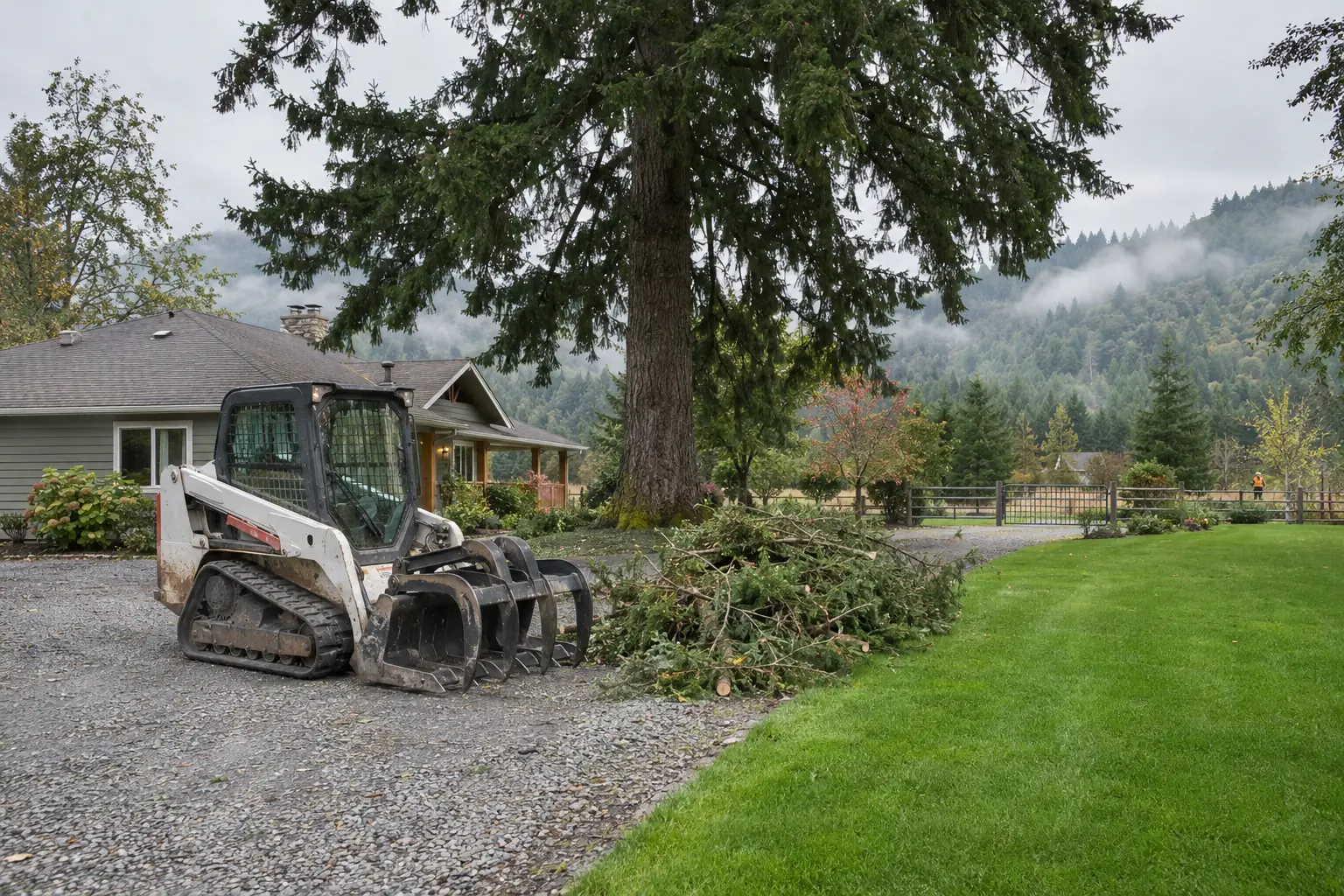
On many rural properties around Grants Pass, conifers have grown up through oak woodland, and drought is now killing many of those firs. Removing the dead and dying ones can give an old oak more room.
OSU Extension's Trees on the Edge says oak stands often mark shallow, clay-rich, droughty soils, and that Douglas-fir deaths are often concentrated within and around the edges of oak woodlands. It says many valley and low-elevation sites were historically ponderosa pine forest or oak woodland kept open by frequent, low-severity fire, and it suggests favoring drought-tolerant trees such as oaks, pines and madrones on high-risk sites. A tree service can take out dead firs near oaks with care so the oak's limbs and roots are not damaged in the process. On larger acreage this ties in with lot clearing and brush removal.
What oak care costs
Oak care is usually billed like other tree trimming, by the tree or by the crew hour, with an arborist visit sometimes charged separately. National guides give a rough range.
LawnStarter's tree trimming cost guide, updated September 24, 2026, puts trimming at $430 to $640 per tree, and $475 to $1,835 for trees over 60 feet. Its arborist cost guide, updated October 9, 2026, puts consultation at $75 to $250 an hour and a written arborist report at $250 to $400. These are national figures, not Grants Pass prices. A big spreading oak over a house, heavy mistletoe work high in the crown, or a lot with no truck access will cost more. The company's written estimate is the price that counts, and the tree service cost guide has ways to keep the cost down.
Questions to ask about your oak
Oaks reward a careful company. These questions help you find one.
- Is the person who will prune an ISA Certified Arborist? You can look up credential holders in ISA's find an arborist directory.
- About how much live wood will come off, and which limbs?
- How will you handle the mistletoe, and when should I expect it back?
- Will you climb with ropes instead of spikes?
- Where will your truck and chipper park, and will they sit on the roots?
- What is your Oregon CCB license number? Check it on the CCB license search or call 503-378-4621.
Oak care around Grants Pass
This free call reaches a tree service for oak work in town yards and on pasture and hillside land around Grants Pass. Many oak jobs pair well with fire spacing work and dead fir removal on the same property.
See the town pages for Murphy, Williams and Selma, or read about general tree trimming. The Tree Service Grants Pass home page explains how the referral works.
Frequently asked questions
Will mistletoe kill my oak?
OSU Extension says mistletoe on oaks usually has negligible effects, though heavy infections can cause branch dieback and add drought stress. Most oaks live with some mistletoe for many years. If the tree is struggling, pruning it out gives a few years of relief and needs repeating.
When is the best time to prune an oak here?
Most light pruning, like dead wood removal, can be done any time. For heavier work, ISA advises pruning before the spring growth flush and avoiding heavy live cuts right after new leaves come out. Fire season saw limits in summer are another reason many people schedule oak work for fall or winter.
Should I water my big native oak in summer?
An established Oregon white oak is adapted to dry summers, and OSU Extension names it among the trees that can handle summer drought once established. Ask an arborist before you start summer watering under an old native oak, since OSU also warns that overwatering can drown roots. Young oaks in their first years may need deep, occasional water at the drip line.
Can a tree service remove mistletoe without cutting branches?
Clumps can be knocked off big limbs, but the plant regrows from inside the branch. Removing the infected branch takes it out for good, which is only sensible on smaller branches. A mix of both is common.
Do I need a permit to prune the oak in my yard?
A tree wholly inside a private yard in Grants Pass generally does not need the city's street tree permit, unless the City Council has named it a Heritage Tree. Oaks in the planting strip or right-of-way need a free city permit. Call the city at 541-450-6000 if you are unsure.